Sales Operations Manual

Salesforce Scenario Playbook

30 real situations from a salesperson's day — each with the exact clicks and the exact words to type. Written for our team, where everyone works in one shared Salesforce login — and where Rohan, your AI sales coach, reads it all.

Sales Playground org Version 7.0 Updated 4 August 2026 Rohan AI coach · LIVE Dialer · Calendly · Email
R
Your AI Sales Head

Meet Rohan

Rohan is your AI sales coach. He reads the whole Salesforce board and posts in #sales-team three times a day — celebrating what you moved, flagging what slipped, and making sure no lead is ever dropped.

10:00 — today's priorities 14:00 — midday progress 18:30 — the day's wrap-up

Tag him anytime. Type @Rohan in Slack and ask — “how am I doing today?”, “which of my deals are at risk?”, “what should I follow up first?” — he reads live Salesforce and answers right there in the thread.

New (Aug 2026): Rohan can now pull up call recordings and full transcripts, give you an AI read of any call (sentiment, talk-ratio, objections, coaching), and he flags anyone under-dialing or padding their task count. Ask “play Namrata’s last call” or “what did the customer object to?”.

The one catch Rohan can only see your work if you follow the three golden rules below. He credits you by the name you sign on your tasks — an unsigned task belongs to nobody, so he can't put it on your scoreboard. Sign your work, log every call, book the next step: that is how Rohan makes you look good.
Updated — August 2026

What’s new since v1

  1. Your calls log themselves. Every dialer call auto-saves to Salesforce with its recording. Stop creating “call” tasks by hand.
  2. Only properly-signed tasks count. Write YOURNAME | Call/Demo – School – purpose. Blank “name call” placeholders are padding — Rohan now flags them instead of praising them.
  3. Set the disposition on every call. Interested / Callback / Not Interested. No disposition = the call never reaches Salesforce and doesn’t count for you.
  4. Rohan can do more. Recordings, transcripts, AI call analysis (sentiment, talk-ratio, objections, coaching), pipeline & at-risk deals — and he flags under-dialing and padding.
  5. Initial Connect no longer errors. A deal moves stage even when the contact has no email (the auto-email just skips).
  6. Call history is protected. Deleting a lead no longer deletes its calls. Still, don’t create a duplicate lead for a number that already exists.

Find your scenario

Something just happened? Find it below and jump straight to the steps.

Part 1 — Every day
1Starting your dayClear overdue items, read today's list
2A new enquiry (lead) has arrivedClaim it with a signed task
3Before you call any schoolRead the timeline first
4Planning future workMake it a task now
5Call connectedSigned comment, Mark Complete, next task
6Call not answeredLog the attempt, move the date
7Ending your dayZero overdue, next steps in place
Part 2 — Moving deals
8A school shows real interestConvert the lead into an Opportunity
9A demo date is fixedStage → Demo Scheduled, event on calendar
10The demo is doneStage → Demo Completed, same day
11Proposal sentStage → Quotation, follow-up task
12The school said yesStage → School Onboarded, payment task
13Silent after the proposalLog attempts, escalate after 3–4
14The deal is lostStage → Closed, record the loss reason
15The lead is junkMark it Junk in ten seconds
Part 3 — Fixing messes
16A task with no owner's nameSign it, or raise it in stand-up
17Clearing an overdue backlogThe 15-minute cleanup
18Two reps on the same schoolEarlier signature owns it
Part 4 — Stand-up
19Answering as a repRead your four answers off the screen
20Running it as the managerRefresh dashboard, open three reports
21Building the three reportsOne-time setup, used forever
Part 5 — Google Calendar
22Putting a demo on the calendarLog it as an Event — it syncs automatically
Part 6 — Dialer · LIVE
23Calls from the dialer log themselvesDialShree calls auto-post as Tasks — don't double-log
24Listen to a call recordingPlay the recording right on the call's record
Part 7 — Meetings (Calendly)
25Book a demo in one clickThe Book Calendly button — pre-fills the school
26A booking logs itselfMeeting auto-lands on the record + pings #sales-team
Part 8 — Email
27Emails with a school land on its recordReceived auto-logs; BCC to capture what you send
Part 9 — Cold calling
28Pick the right dispositionYour tap decides if a lead is created — and your credit
29You got an interested cold callTurn the “Cold Call 98…” placeholder into a real lead
30You closed a sale on a cold callConvert to a Closed Won Opportunity so it counts
Before anything

The three golden rules

We all work in one shared Salesforce account (“MLC Team”). Salesforce — and Rohan — cannot tell who did what unless you sign your work. These three rules are the whole game: follow them and Rohan coaches you accurately; break them and your effort goes uncredited.

RuleWhat it means
1. Sign your workEvery task subject starts with your name in capitals and a | — “NAMRATA | Call – IMS Noida – demo follow-up”. Every comment starts with REP: your name. No signature means the work belongs to nobody — and Rohan cannot credit you for it.
2. Write it downEvery call, demo and proposal gets logged the moment it happens. If it is not in Salesforce, it did not happen.
3. Close the loopWork finished → Mark Complete → create the next task. Never leave finished work showing as Open.
Subject formula NAME | Action – School – Purpose.  Actions: Call / Demo / Proposal / Follow-up / Payment. Example: “HARSH | Proposal – Arch College – ERP quote for 1200 students”.
Part 1

Every day

The daily rhythm: open your list, work it, log everything, close the day clean.

1Starting your dayIndex ↑
WhenEvery morning — before WhatsApp, before anything else.
  1. Log in to Salesforce → click Tasks in the top bar.
  2. Click the next to the list name → choose Open Tasks. (Our org's views: Open Tasks, Today's Tasks, Overdue Tasks, Recently Completed Tasks.)
  3. Type your name in the Search this list... box — now you see only your tasks.
  4. Red dates are late. Handle every red one first: done in real life → Scenario 5. Still pending → move its Due Date to today or tomorrow. Dead → comment why, then Mark Complete.
  5. Read today's tasks top to bottom. That is your day plan.
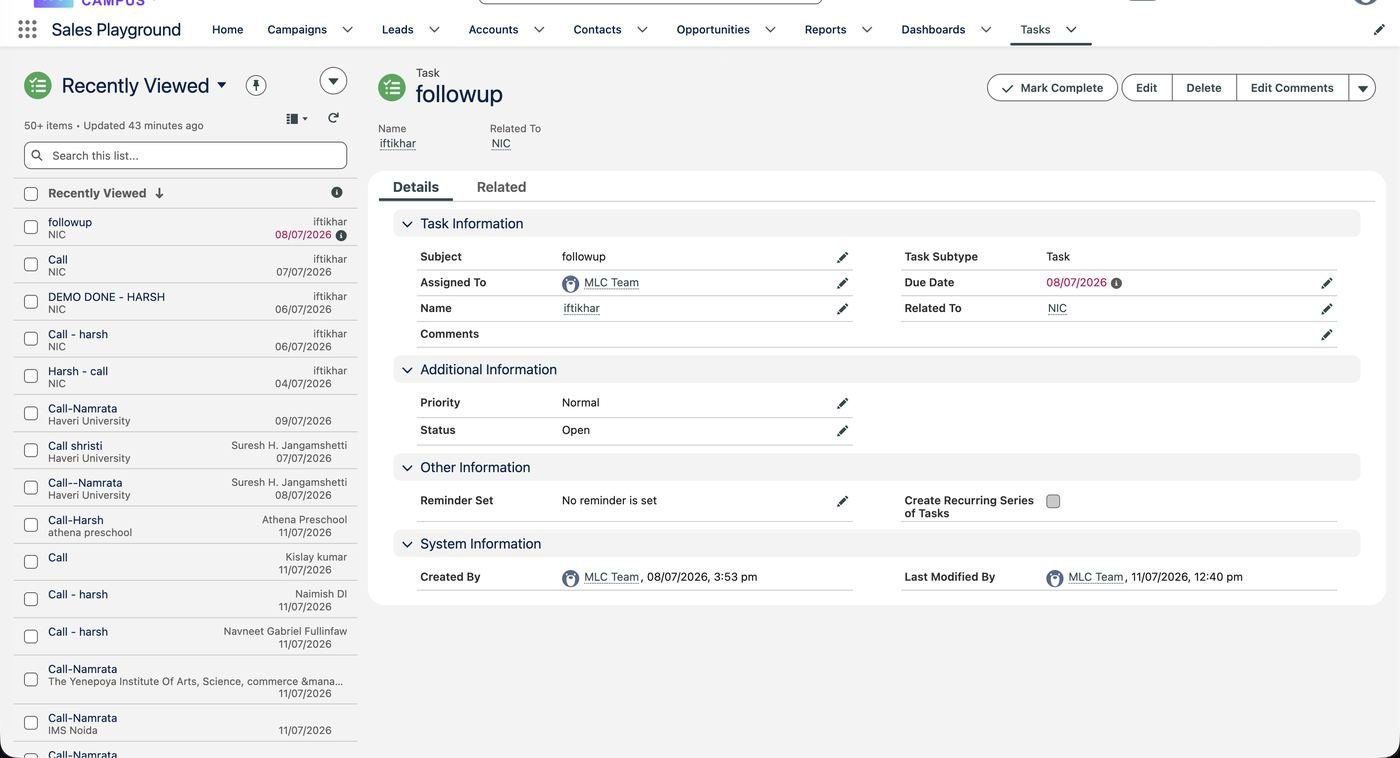
Tasks tab
The Tasks tab — list on the left, task detail and the Mark Complete button on the right.
Done whenZero red tasks under your name, and you know your first three calls of the day.
2A new enquiry (lead) has arrivedIndex ↑
WhenA school filled the website form, booked on Calendly, or met us at an exhibition.
  1. Click Leads — the new lead shows status New.
  2. Open it. Check the Activities panel (right side) first. Empty — it's free, you can take it. Someone's signed tasks — it's theirs (Scenario 18).
  3. Taking it? Create the first task right in the Activities panel so it links automatically:
Type this
Subject:   NAMRATA | Call – Sunrise Public School – first contact
Due Date:  today
Comments:  New lead from website. 800 students (from form).
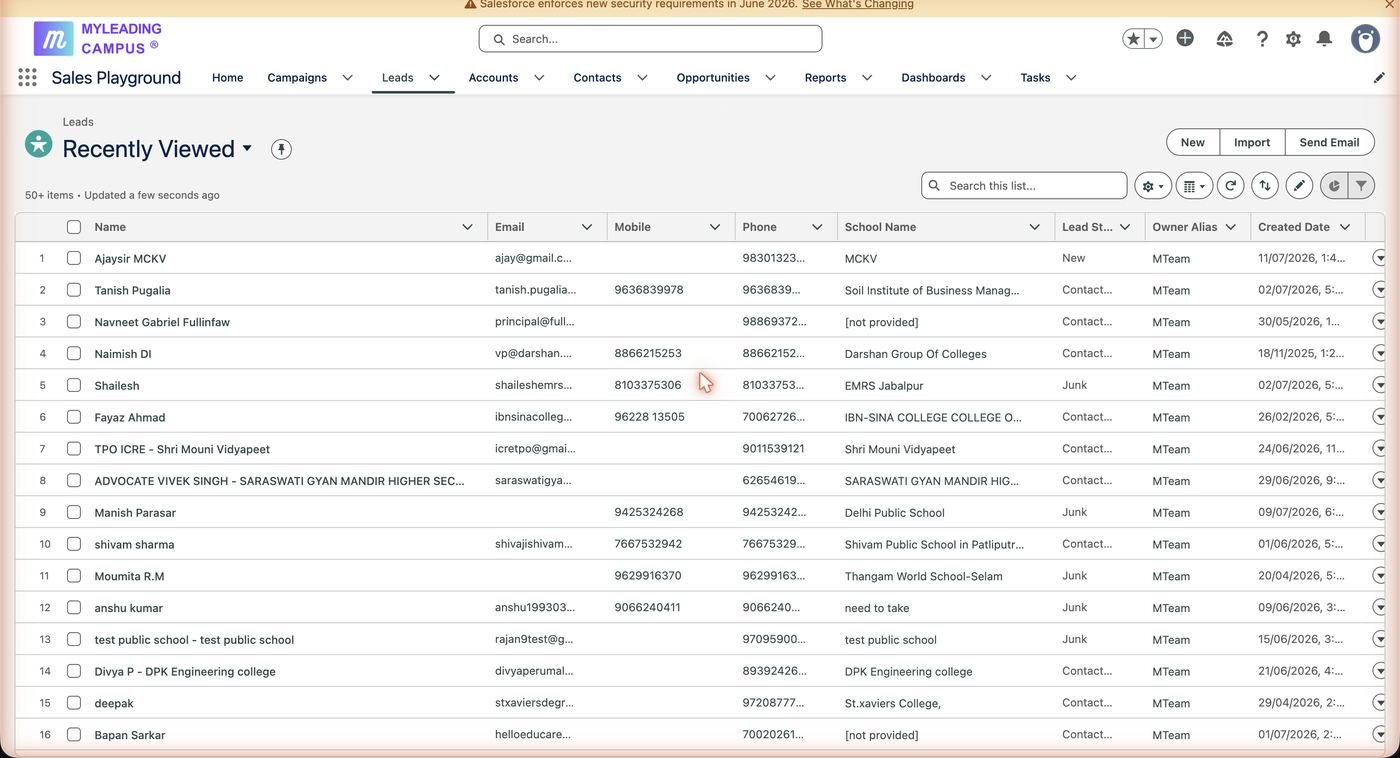
Leads list
The Leads tab — new enquiries wait here with status “New”.
Done whenThe lead has a signed task with today's date. The school now has an owner — you.
3Before you call any schoolIndex ↑
WhenEvery time, before dialing — twenty seconds that prevent embarrassment.
  1. Open the school's lead or opportunity page.
  2. Read the Activity timeline on the right: who called last, what was promised, which stage the deal is in.
  3. If the last signed activity belongs to another rep — it's their school. Don't call; ask them instead.
  4. Read the last OUTCOME and NEXT STEP comment, and start your call from there (“You had asked about WhatsApp integration…”), not from zero.
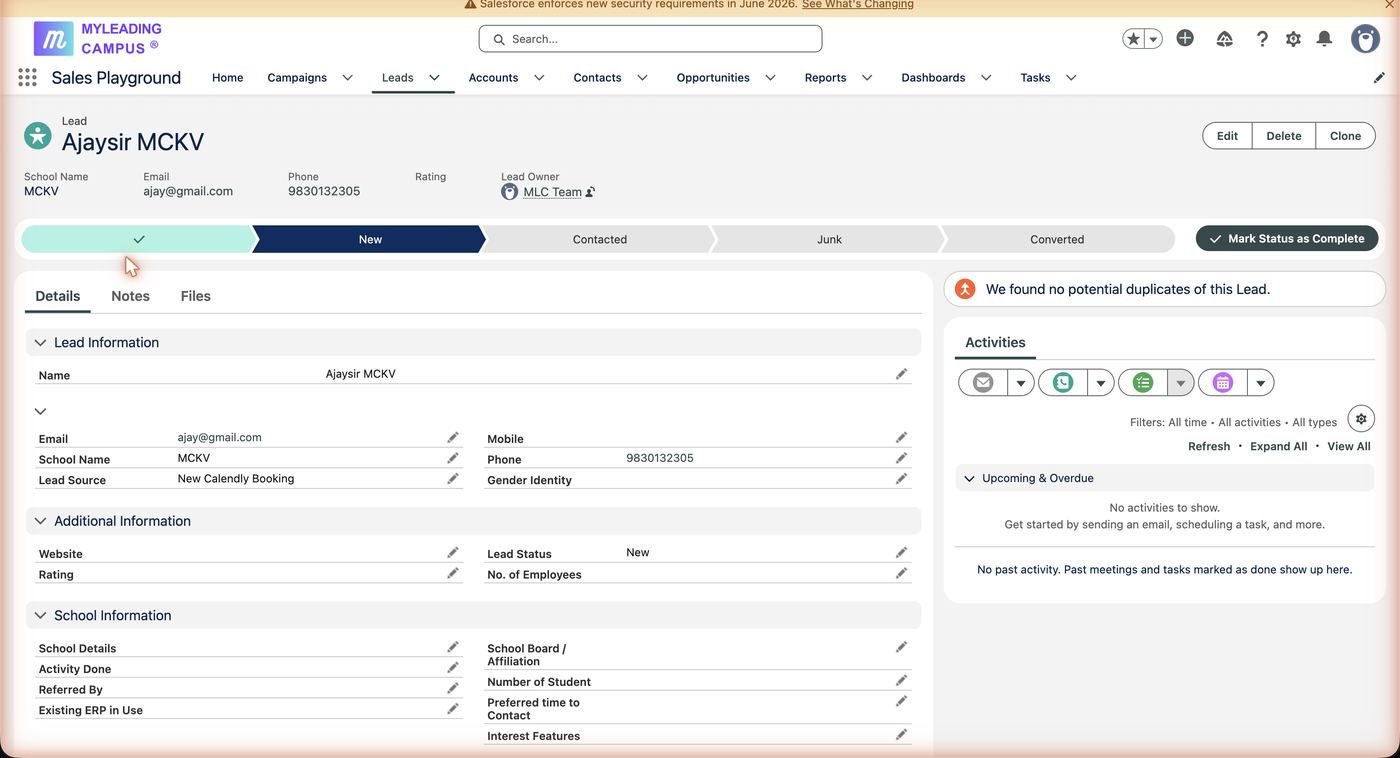
Lead record
A lead page — status path on top, the school's full history in the Activities panel.
Done whenYou know the school's history, and it's yours to call.
4Planning future workIndex ↑
WhenAny time you think “I must call, demo or send something later.” It becomes a task now, or it gets forgotten.

Best way: open the school's page → Activities panel → New Task (it links automatically). Otherwise: Tasks tab → New Task. Fill it in like this:

FieldWhat to writeExample
SubjectNAME | Action – School – PurposeNAMRATA | Call – Sunrise Public School – fee module pricing
Assigned ToLeave as MLC Team — your subject line is the signatureMLC Team
Due DateThe day you will really do it. Never blank.13/07/2026
NameThe contact personMr. Rajesh Sharma (Principal)
Related ToThe school's account or opportunitySunrise Public School
CommentsWhy this task existsPrincipal asked pricing for 800 students.
New Task form
The New Task form — fields marked with * are required.
Write it like this“HARSH | Call – Kiran Medical College – pricing discussion”
Not like this“Call-Namrata”, “followup”, “Call” — no school, no purpose; it can't be searched and can't be counted.
Done whenThe future work sits in Salesforce with your name, a school and a date — it can no longer be forgotten.
5Call connectedIndex ↑
WhenThe moment you hang up. Sixty seconds — the most important habit in this playbook.
  1. Open the task → pencil icon next to Comments → write four lines:
Type this
REP: Namrata
TALKED TO: Mr. Rajesh Sharma (Principal)
OUTCOME:  Interested in fee module. Wants demo next week. Asked about WhatsApp integration.
NEXT STEP: Demo on Tuesday 15/07, 11 am, online.
  1. Click Save, then Mark Complete.
  2. Immediately create the next task (Scenario 4): “NAMRATA | Demo – Sunrise Public School – fee module, online”, due 15/07.
  3. Did the deal move forward? Update the stage as well (Scenarios 9–12).
Done whenOld task Completed, comment saved, next signed task exists. Your stand-up numbers update themselves.
6Call not answeredIndex ↑
WhenNo answer, switched off, busy — you still log it, still sixty seconds.
  1. Open the task → Comments:
Type this
REP: Namrata
TALKED TO: — (no answer, 2 attempts, 11:30 am and 4 pm)
OUTCOME:  Phone not picked. WhatsApp sent asking for a good time.
NEXT STEP: Try again tomorrow morning.
  1. Do not Mark Complete. Instead: pencil next to Due Date → change to tomorrow → Save.
NeverHang up and walk away, leaving the task to turn red. That is exactly how the org ended up with fifty overdue tasks nobody can explain.
Done whenThe task shows tomorrow's date and the attempt is on record.
7Ending your dayIndex ↑
WhenThe last five minutes before you leave.
  1. Tasks → Today's Tasks → search your name.
  2. Anything still Open that you actually did? Scenario 5 treatment — comment and complete.
  3. Anything you couldn't do? Move its date honestly (tomorrow, not “someday”).
  4. Quick check: does every school you touched today have a next signed task? If not, create it now.
Done whenNone of your tasks are red, and tomorrow's stand-up answers are already sitting in Salesforce.
Part 2

Moving deals

A deal moves right only when reality moves right. This is our pipeline:
New Initial Connect Demo Scheduled Demo Completed Quotation School Onboarded Closed
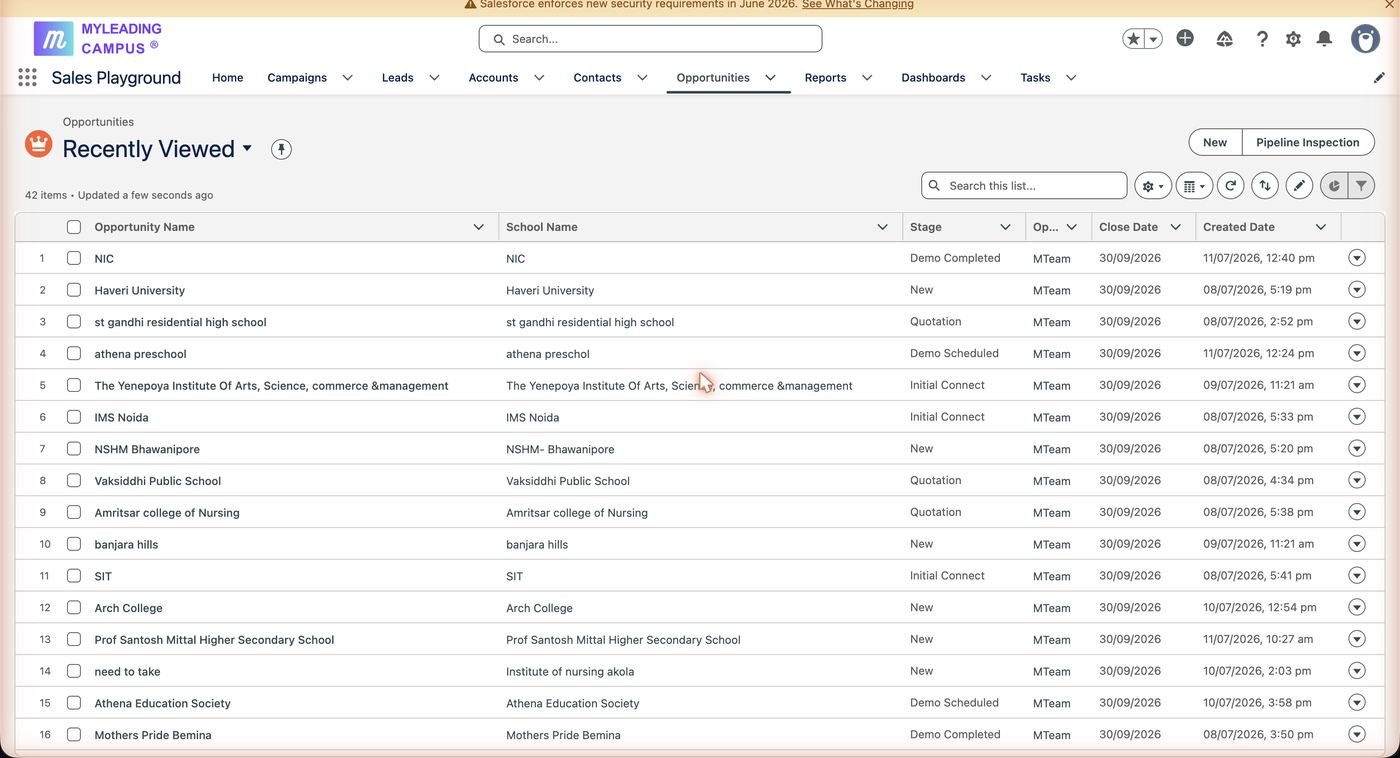
Opportunities list
The Opportunities tab — every deal with its current stage and close date.
8A school shows real interestIndex ↑
WhenOn a call, the school agrees to a demo or asks for a proposal. The lead has graduated.
  1. On the lead: log the call (Scenario 5 comment style), status path → ContactedMark Status as Complete.
  2. Click Convert. Salesforce creates an Account (the school), a Contact (the person) and an Opportunity (the deal).
  3. Open the new opportunity and set:
Set these fields
Stage:       Demo Scheduled   (or Initial Connect if the demo isn't fixed yet)
Amount:      2,40,000         (yearly value — never leave 0)
Close Date:  30/09/2026       (honest estimate)
Description: REP: Namrata (since 12/07/2026)
  1. Demo already fixed? Put it on the calendar as an Event — Scenario 22.
Done whenThe deal exists as an opportunity with your name in Description, a stage, an amount and a next step.
9A demo date is fixedIndex ↑
WhenDate and time agreed with the school. (“We'll demo sometime” does not count.)
  1. Open the opportunity → path → click Demo ScheduledMark Stage as Complete.
  2. Log the demo as an Event (not a task) with the real date and time — Scenario 22. It lands on the team's Google Calendar automatically.
Done whenStage reads Demo Scheduled and the demo shows in Google Calendar.
10The demo is doneIndex ↑
WhenThe same day as the demo — before you go home, not tomorrow.
  1. Open the demo event (or task) → write the outcome in its description or comment:
Type this
REP: Namrata
TALKED TO: Principal + accountant (40 min, online)
OUTCOME:  Demo went well. They want a quote for 800 students incl. WhatsApp module.
NEXT STEP: Send proposal by tomorrow evening.
  1. If it was a task: Mark Complete.
  2. Opportunity path → Demo CompletedMark Stage as Complete.
  3. Create the task: “NAMRATA | Proposal – Sunrise Public School – quote 800 students”, due tomorrow.
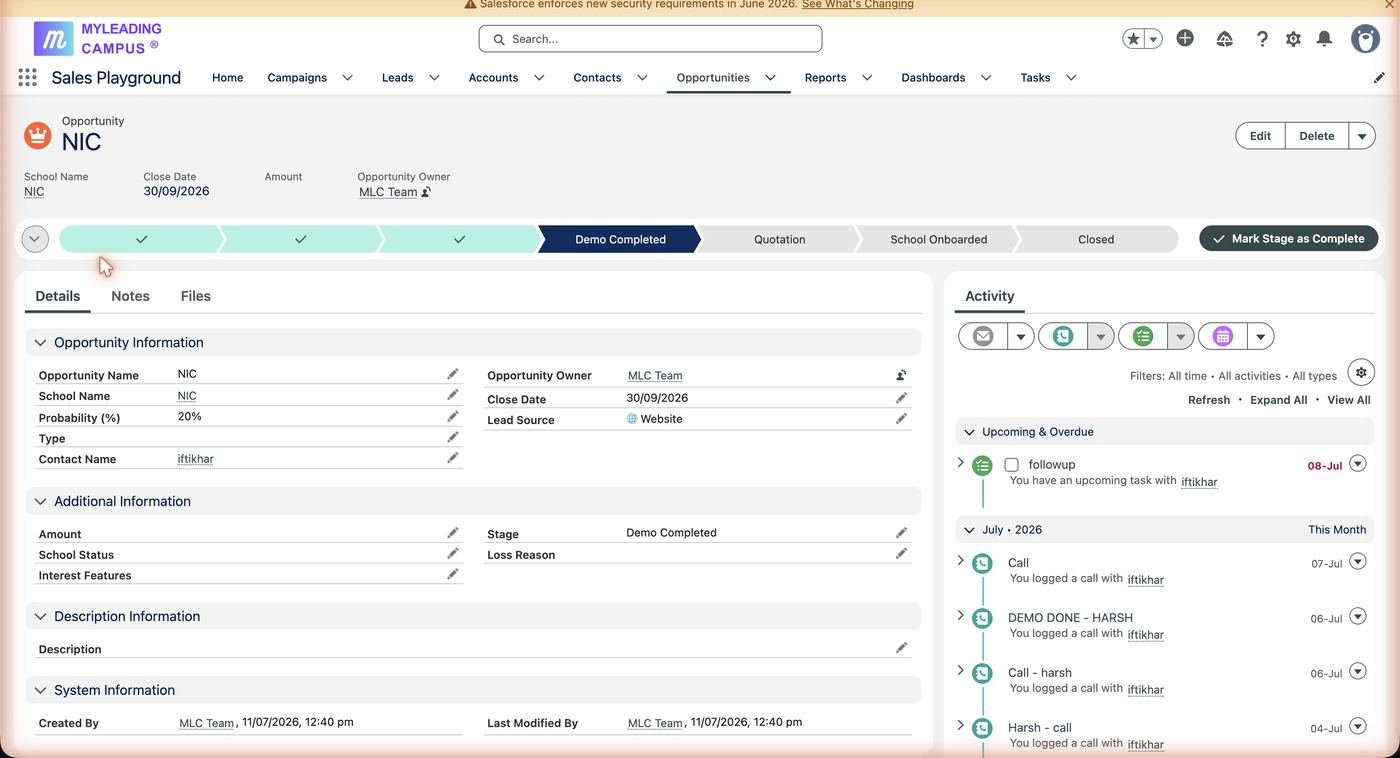
Opportunity record
A healthy deal (the real NIC opportunity) — stage path on top, every call logged in the activity timeline.
Done whenIn tomorrow's stand-up, “demos completed: 1” is already on screen. Nobody has to ask.
11Proposal sentIndex ↑
WhenThe moment the email or WhatsApp with the quote goes out.
  1. Open the proposal task → comment, with the numbers:
Type this
REP: Namrata
OUTCOME:  Quote emailed: ₹2.4L/yr, 800 students, fee + WhatsApp modules. CC'd manager.
NEXT STEP: Follow up Monday for feedback.
  1. Mark Complete → stage → QuotationMark Stage as Complete.
  2. Update Amount on the opportunity if the quote changed it.
  3. Create the task: “NAMRATA | Follow-up – Sunrise Public School – proposal feedback”, due in 2–3 days.
Done whenStage = Quotation. In stand-up, “proposals sent” means deals that entered this stage — no stage move, no credit.
12The school said yesIndex ↑
WhenVerbal or written agreement to go ahead.
  1. Log the winning call (Scenario 5) → Mark Complete.
  2. Stage → School OnboardedMark Stage as Complete. This is what “deal closed” means in stand-up.
  3. Check that Amount and Close Date hold the final real numbers.
  4. Create the task: “NAMRATA | Payment – Sunrise Public School – collect advance + agreement”, due this week.
  5. Say it loudly in tomorrow's stand-up.
Done whenStage = School Onboarded, the amount is correct, and a payment task is alive.
13Silent after the proposalIndex ↑
WhenNo reply for days after the quote went out.
  1. The deal stays in Quotation — don't touch the stage.
  2. Keep one follow-up task alive. Each attempt: add a line to its comments (“3rd attempt 16/07 — no answer, WhatsApp sent”) and move the due date forward. The comment history becomes proof of your effort.
  3. After 3–4 failed attempts: raise it in stand-up as a blocker — “waiting for customer response”. The manager decides: keep chasing or close it.
Done whenThe silence is visible in Salesforce — attempts logged, not hidden in your memory.
14The deal is lostIndex ↑
WhenThey chose a competitor, have no budget, or said no.
  1. Stage → ClosedMark Stage as Complete.
  2. Fill Loss Reason honestly: too costly / chose competitor / no budget / went silent.
  3. Final comment on the opportunity: “REP: Namrata. Lost to [X] because [Y]. Reconnect possible in [month].”
  4. Close any open tasks on it (with a comment saying why). Then move on — no zombie deals.
Done whenThe pipeline shows only living deals, and the team learns why we lose.
15The lead is junkIndex ↑
WhenWrong number, not a school, zero interest, no budget — and you're sure.
  1. On the lead: status path → JunkMark Status as Complete.
  2. One-line comment: “REP: Harsh. Wrong number — it's a shop.” Ten seconds that save the next person an hour.
Done whenThe junk is out of everyone's way. A clean lead list is a faster team.
Part 3

Fixing messes

Things go wrong. Here is how to put them right — fast.

16A task with no owner's nameIndex ↑
WhenA subject like “followup” or “Call” — nobody's signature on it.
  1. Yours? Edit → add “YOURNAME | ” at the front, plus the school and purpose.
  2. Not yours or unknown? Raise it in stand-up: whose is this? Every task gets an owner, or gets closed.
Done whenZero anonymous tasks in the org.
17Clearing an overdue backlogIndex ↑
WhenBack from leave, or cleaning up the old mess (like our current 50+).

Fifteen minutes, three questions per task, no mercy:

  1. Did it actually happen? Write the real outcome in comments → Mark Complete.
  2. Still needs doing? Move the due date to a real day this week.
  3. Dead? Comment why (“school closed the topic”) → Mark Complete.
Done whenYour name search shows zero red — and Scenario 1 keeps it that way.
18Two reps on the same schoolIndex ↑
WhenYou open a record and see another rep's signed tasks (it happened with Haveri University).
  1. The rep with the earlier signed activity owns the school. The other stops immediately.
  2. Not sure, or both old? Decide in stand-up in thirty seconds; the hand-over is written as a comment.
  3. Prevention is Scenario 3: always read the timeline before dialing.
Done whenOne school, one owner, one signature on all its new tasks.
Part 4

Stand-up

Ten minutes every morning. Four questions. Every answer comes off a screen, not from memory.

19Answering as a repIndex ↑
WhenEvery morning, four questions. If you lived Scenarios 1–7, the answers are already there.
QuestionWhere your answer is
1. What did you complete yesterday?Tasks → Recently Completed Tasks → search your name. Calls = completed call tasks; demos = completed demo events; proposals = your deals that entered Quotation; closed = deals that entered School Onboarded.
2. What are you doing today?Tasks → Today's Tasks → search your name. Read it out.
3. Any blockers?Tasks → Overdue Tasks → search your name — the comments say why: waiting for customer, pricing approval, technical clarification, payment pending.
4. Next committed outcome?The next signed task you created (Scenario 5, step 3). Say it: “Demo with XYZ School Tuesday — the task is in.”
Done whenAll four answered in under two minutes, without touching your memory.
20Running it as the managerIndex ↑
WhenFive minutes before the meeting.
  1. DashboardsSales DashboardRefresh. A two-week-old dashboard lies.
  2. Open the three stand-up reports (Scenario 21) in three tabs.
  3. Go person by person — each rep's name-block is visible in every report, because signed subjects sort alphabetically.
  4. Closing rule: every rep's “next committed outcome” must exist as a signed task before the meeting ends. Not a task — not a commitment.
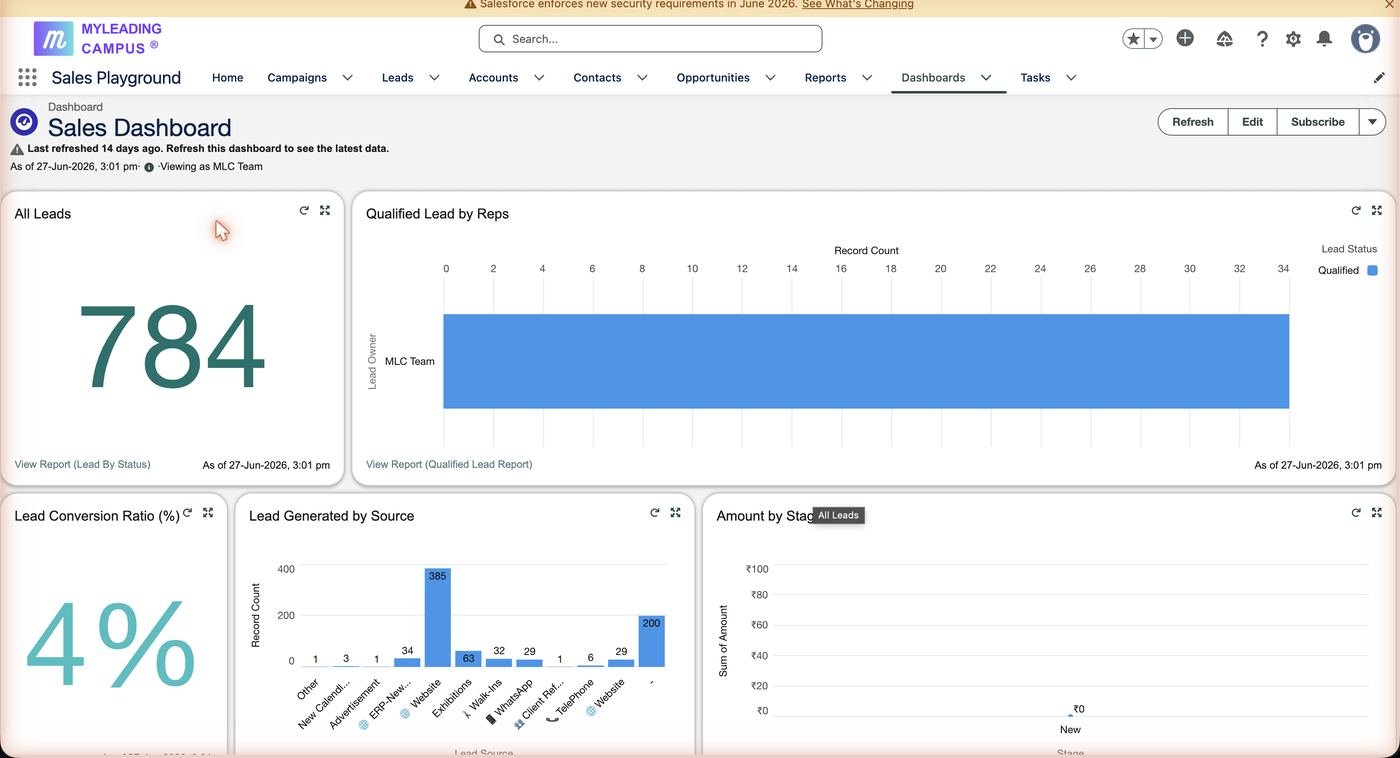
Sales Dashboard
The Sales Dashboard — team totals. “Qualified Lead by Reps” always shows one MLC Team bar in our shared-login setup; per-person numbers come from the signed-subject reports.
Done whenEvery number discussed came off a screen.
21Building the three reportsIndex ↑
WhenOnce, today. Then they run forever.
  1. ReportsNew Report → search “Tasks” → choose Tasks and Events → Start Report.
  2. Filters: Show Me = All Activities; Date = Completed Date – Yesterday; add Status equals Completed.
  3. Columns: Subject, Related To, Comments. Sort by Subject — the name signatures group each rep's work automatically.
  4. Save & Run → name it “Stand-up 1 — Completed Yesterday” → save in Public Reports.
  5. Repeat twice with different filters:
ReportFiltersAnswers
Stand-up 1 — Completed YesterdayStatus = Completed, Completed Date = Yesterday“What did you complete yesterday?”
Stand-up 2 — Due TodayStatus = Open, Due Date = Today“What are you doing today?”
Stand-up 3 — Overdue (Blockers)Status = Open, Due Date < Today“Any blockers?”

To isolate one person, add the filter “Subject contains NAMRATA” — or simply use the search box on any task list view.
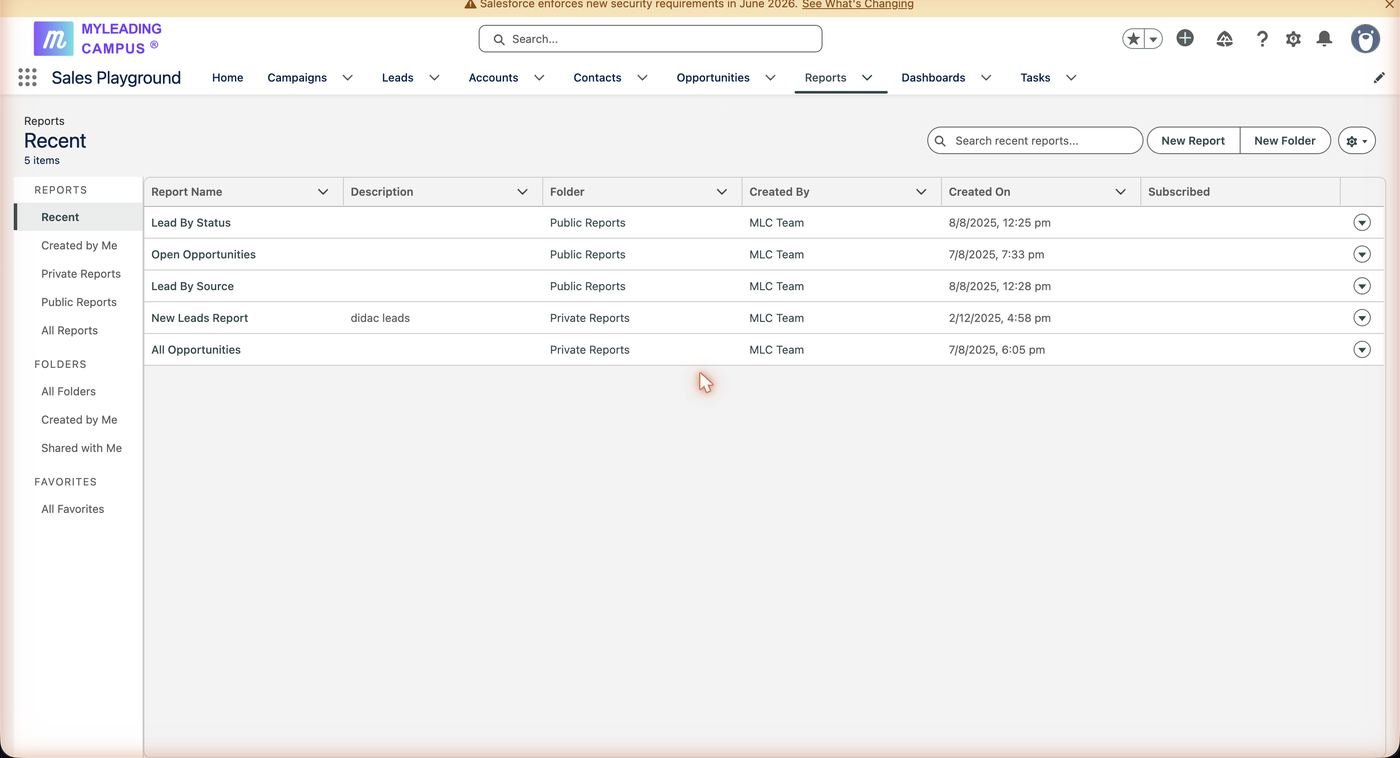
Reports tab
The Reports tab — the three stand-up reports join the existing sales reports here.
Done whenThree reports exist in Public Reports and open in one click every morning.
Part 5

Google Calendar

Salesforce is connected to the team's Google Calendar (Einstein Activity Capture, since July 2026). One rule: Events sync to Google Calendar — Tasks never do. Fixed date and time (demo, meeting) = Event. To-do work (calls to attempt, proposals to send) = Task. Changes sync both ways.

22Putting a demo on the calendarIndex ↑
WhenA demo or meeting gets a fixed date and time. This replaces creating a demo task (see Scenario 9).
  1. Open the school's opportunity (or lead) → Activity panel on the right.
  2. Click the calendar icon (New Event) — next to the email, call and task icons.
  3. Fill it in — signed, like everything else:
Type this
Subject:     NAMRATA | Demo – Sunrise Public School – fee module
Start:       15/07/2026, 11:00 am
End:         15/07/2026, 11:45 am
Description: Principal + accountant attending. Google Meet link: [paste].
             REP: Namrata
  1. Save. Within a few minutes the event appears in the team's Google Calendar — visible on every rep's phone that subscribes to it.
  2. Time changed? Move it in either place — Salesforce or Google Calendar — and the other side updates automatically.
  3. After the demo, continue with Scenario 10 (stage → Demo Completed, outcome in the event's description).
Don'tCreate a Task for a demo and expect it on the calendar — Tasks never sync to Google Calendar. Fixed date + time = Event, always.
Done whenThe demo shows in Google Calendar with your name in the title — the whole team sees the day's demos without opening Salesforce.
Part 6 · Now live

Dialer

Calls made on the DialShree dialer now write themselves into Salesforce — automatically, with the disposition, duration and a playable recording. This removes the manual “log the call” step for dialer calls (only for dialer calls — your personal-mobile calls still need Scenario 5).

23Calls from the dialer log themselvesIndex ↑
WhenYou make or take calls through the DialShree dialer (not your personal mobile).
Live since July 2026The dialer connection is switched on and proven. Every DialShree call now posts itself into Salesforce — you do nothing.
  1. Do nothing. Every dialer call posts itself as a Completed Task on the matching Lead or Contact — subject “DialShree Call – <disposition>”, with the agent, campaign, number, duration and a link to the recording — a minute or two after you hang up.
  2. It matches by phone number. If a call doesn't appear on a Lead, that Lead's Phone or Mobile is probably missing or wrong. Fix the number on the Lead so future calls attach. (Calls with no matching Lead still get logged, just unlinked — a manager reviews those.)
  3. Don't double-log. If the dialer already logged the call, don't also type a manual call log for the same call — you'd end up with two Tasks. Just add a comment (Scenario 5 style) to the auto-created Task if you want to add detail or the outcome.
  4. Personal-mobile calls still need Scenario 5. Only DialShree calls auto-log. Anything you dial from your own phone, you log by hand as usual.
Auto-logged DialShree call
A dialer call that logged itself — agent, campaign, number, disposition and duration in the Comments, with a Call Recording panel on the right.
Done whenDialer calls appear on the Lead's timeline on their own, and the only calls you log by hand are the ones from your personal mobile.
24Listen to a call recordingIndex ↑
WhenYou want to hear what was actually said — before a follow-up, during a hand-over, or to settle a “what did they promise?” question.
  1. Open the school's Lead or Contact → Activities panel → click the DialShree Call you want to hear (or open it from the Tasks list).
  2. On the call's record, find the Call Recording panel (right side).
  3. Press ▶ Play — the recording plays right there, in the page. No download, no separate app.
Call Recording player on a call record
The Call Recording panel — press play and the call plays in the page.
If it doesn't playA recording only exists for calls that actually connected long enough to record. Very short / unanswered calls may have none — the panel will say so.
Done whenYou've heard the call and can act on what was really said — not on memory.
Part 7 · Now live

Meetings

Salesforce is connected to Calendly. Book a demo straight from a school's record with the details pre-filled — and every booking logs itself onto the record and pings #sales-team in Slack. No copy-pasting names or emails, no manual meeting log.

25Book a demo in one clickIndex ↑
WhenA school agrees to a demo and you want to send them a booking link — with their name and email already filled in.
  1. Open the school's Lead or Contact record.
  2. Click the Book Calendly button in the top-right action bar (next to Edit / Delete).
  3. Our Calendly booking page opens in a new tab with the school's name and email already pre-filled — just pick the demo type / slot, or share the link with them.
Book Calendly button on a Lead
The Book Calendly button on a Lead — one click opens Calendly with the school's name and email pre-filled.
Why it mattersThe invitee details come straight from Salesforce, so the booking always matches the right school — which is what makes Scenario 26 (auto-logging) work.
Done whenThe school has a booking link (or a booked slot) with their details already in it — no retyping.
26A booking logs itselfIndex ↑
WhenAnyone books, reschedules or cancels a meeting through Calendly.
  1. Do nothing in Salesforce. The meeting posts itself as an activity on the matching Lead/Contact (matched by the invitee's email) — “Calendly Meeting – <name>”, with the time. A cancellation updates it too.
  2. At the same moment, a message drops into #sales-team in Slack (📅 new booking / ❌ cancelled) with the invitee, the time and the host.
  3. Still move the deal. Auto-logging records the meeting; it does not move your pipeline. When the demo is fixed, set the opportunity stage to Demo Scheduled (Scenario 9); after it happens, Demo Completed (Scenario 10).
Calendly meeting logged on a record
A Calendly booking that logged itself onto the school's record — matched automatically by the invitee's email.
Match by emailThe booking attaches only if the invitee's email matches a Lead or Contact in Salesforce. If a booking doesn't appear on a record, the email on that Lead/Contact is missing or different — fix it so future bookings attach.
Done whenThe meeting is on the school's timeline and in #sales-team without anyone logging it — and the opportunity stage reflects it.
Part 8 · Now live

Email

Emails you exchange with a school now attach to its Salesforce record automatically, so the whole conversation lives on the timeline — not just in your inbox. Received emails log on their own; to also capture what you send, add one BCC line to your mailbox once.

27Emails with a school land on its recordIndex ↑
WhenYou email a school from your @myleadingcampus.com mailbox, or a school emails you.

Received email — automatic. When a school emails your work mailbox, it logs itself as an activity on the matching Lead/Contact (matched by the sender's email). You do nothing.

Sent email — one-time setup, then automatic. To capture what you send, add this BCC to your mailbox once (Hostinger webmail → ⚙ Settings → Account → Bcc field → paste → Save):

BCC address — paste once into your mailbox settings
lead_email_capture@1w78hjt9mvdgzg14ceqn4imrdeb3cgye9svde3o2rmkeqjtu1m.wd-76tuxmau.ind116.apex.salesforce.com

After that, every email you send to a school is silently copied to Salesforce and lands on that school's record — matched by the recipient's email.

Email logged on a lead
An email on the school's timeline — the conversation lives on the record, not just in an inbox.
Two things to know1) It attaches only when the school's email matches a Lead/Contact — keep email addresses on records correct. 2) Salesforce also sends on behalf of @myleadingcampus.com (verified domain), so emails from Salesforce look like they came from us, not a stranger.
Done whenYour email trail with each school sits on its Salesforce record — visible to whoever picks the school up next.
Part 9 · Cold calling

Cold calling

Cold calls run through the DialShree dialer and log themselves (Part 6). But two things are on you — and both decide whether your effort ever counts: picking the right disposition, and working the interested ones. Get these wrong and a real prospect — even a closed sale — vanishes.

28Pick the right disposition — it decides everythingIndex ↑
WhenEvery cold call, the moment you hang up — you choose an outcome in the dialer.

Your disposition is not admin — it is the switch that decides whether a lead is created and whether you get credit. Tell the truth about what happened:

You tap…What it meansWhat happens
InterestedThey want to know more.✅ Lead created
Call Back / Callback“Call me later.”✅ Lead created
Follow UPReal conversation, more to do.✅ Lead created
Sale MadeThey said yes.✅ Lead → then Scenario 30
ConnectedVague “I talked to someone.”❌ No lead — the trap
Not InterestedA clear no.Logged, no lead — respect it
Busy / No AnswerDidn't reach a person.Logged, no lead
Don'tDump everything into “Connected.” It creates no lead and tells us nothing. If the person was keen, tap Interested or Call Back — otherwise that hot lead is never created and your good call counts for nothing.
Done whenEvery call carries its true outcome — so the interested ones become leads and the dead ones stay out of the pipeline.
29You got an interested cold call — make it a real leadIndex ↑
WhenA cold call went well and you tapped Interested / Call Back. The system just made a placeholder lead named “Cold Call 98…” — flesh it out while it's fresh.
WhyA lead called “Cold Call 9405812160” with no name and no next step is not workable — it sits and goes cold. Two minutes now turns it into a real prospect.
  1. Open Leads → find your new “Cold Call <number>” (Status New, at the top). Or open it straight from your call in the Activities list.
  2. Edit and fill in what you learned: Last Name (the person / school — replace “Cold Call 98…”), Company (the school), Email, and their need in the Description.
  3. Sign it & book the next step — create a Task: NAME | Follow-up – School – what you agreed, dated for when you promised to call back (Scenario 5 style).
  4. Save. It's now a named, owned, workable lead with a next step — not a stray phone number.
Rohan is watchingLeave an interested lead with no next step booked and Rohan flags it in #sales-team with your name on it. Book the follow-up before you move to the next call.
Done whenThe placeholder has a real name, a school, and a signed next-step task — and Rohan counts it as your live prospect.
30You closed a sale on a cold call — make it countIndex ↑
WhenA cold call ended in a yes and you tapped Sale Made. That tap is not the sale — the sale only exists once it's an Opportunity marked Closed Won.
The trap“Sale Made” is only a note on a call. On its own it puts zero in the pipeline and the numbers. A sale nobody recorded is a sale that didn't happen — no credit, no revenue on the board.
  1. Open the Lead (the “Cold Call 98…” one, or the existing school lead the call attached to).
  2. Fill in the real details first (Scenario 29) so the record is clean.
  3. Click Convert — turn the Lead into an Account + Contact + Opportunity (Scenario 8 walks the convert screen).
  4. On the new Opportunity: set the Amount, move the Stage to School Onboarded / Closed Won, and create the payment task (Scenario 12).
Why it mattersRohan's forecast and the company's revenue numbers count Opportunities, never call notes. A “Sale Made” that never became a Closed Won Opportunity is invisible to both. Convert it — or it didn't happen.
Done whenThe sale is a Closed Won Opportunity with an Amount — it shows in the pipeline, the revenue numbers, and against your name.
Reference

Cheat sheet

The two templates the whole system runs on. Copy, replace the brackets, done.

Task subject (replace NAME with your name in capitals)

Copy-paste
NAME | Call – [School] – [purpose]
NAME | Demo – [School] – [module], [online/at school]
NAME | Proposal – [School] – [what you are quoting]
NAME | Follow-up – [School] – [what you are chasing]
NAME | Payment – [School] – [what to collect]

After-call comment

Copy-paste
REP: [your name]
TALKED TO: [name + role]
OUTCOME:  [what they said, 1–2 lines]
NEXT STEP: [what happens next + when]
Remember If it is not in Salesforce, it did not happen. And in a shared account, work without your name on it is work nobody can credit you for.